
Spider mite
Tiny sap-sucking mites that speckle leaves and spin fine webs. They thrive in hot, dry, still air and build up fast, so act at the first speckles.
Symptoms
- Tiny pale or yellow speckles (stippling) on the top of leaves, starting on a few leaves and spreading.
- Minute moving dots and round eggs on the underside of leaves, visible with a loupe or hand lens.
- Leaves turn dull, bronzed or greyish and may dry out and drop.
- Fine silk webbing over leaf undersides, shoot tips and flowers in heavier attacks.
Quick checks
How to fix it
- 1Environment
Cool the tent and bring humidity up into range
Keep the canopy within 20–27 °C and humidity towards the top of your week's chart range, with gentle air movement. In late flower, never go above the chart range, because grey mould is the bigger risk. Higher humidity slows mites down but won't control them on its own.
- 2Physical
Remove and isolate
Cut off the worst-affected leaves, bag them and take them out of the tent. Move a badly affected plant away from the others if you can. Wipe or rinse leaf undersides with plain water to knock numbers down.
- 3Biological
Release predatory mites early
For an outbreak, release Phytoseiulus persimilis on the infested plants as soon as they arrive. They eat all stages of spider mite and work best at about 20–25 °C with humidity above about 70%, but struggle above 30 °C. For prevention or light numbers, Amblyseius andersoni or A. californicus can live on other food and keep going when mites are scarce. A predatory midge (Feltiella acarisuga) is another option. Repeat releases as the supplier advises.
- 4Safe treatment
Safe sprays in the growth stage only
If numbers are too high for predators, use an insecticidal soap (fatty acids) or plant-oil spray approved for amateur use in the UK, in the growth stage or very early flower. Cover the leaf undersides, test on one leaf first and repeat every 3–5 days (or as the label says) to catch new hatchlings. Don't spray and release predators at the same time: check the label for compatibility.
- 5Support
Help the plant recover
Keep Stress in the feed every week, and once the mites are under control, Monkey Mist can help the plant bounce back from pest pressure in growth and early flower.
Likely causes
- Hot, dry, still air: mites breed fastest in warm, low-humidity conditions.
- Mites brought in on new plants or cuttings, clothing or tools (especially after gardening or handling houseplants).
- Plants packed closely together with leaves touching, so mites walk from plant to plant.
- Mites surviving from a previous run in debris, canes or the tent itself.
What to avoid
- Don't spray developing or maturing flowers: it leaves residue and invites mould.
- Don't rely on sticky traps: spider mites don't fly, so traps won't catch them.
- Don't keep the tent hot and dry, which is exactly what mites like.
- Don't use household chemicals or homemade mixes not approved for plant use.
- Don't move from an infested plant to a clean one without washing your hands and changing your top.
Prevention
- Quarantine new plants or cuttings for 1–2 weeks and inspect them closely.
- Keep temperature and humidity in the chart ranges with steady air movement.
- Check leaf undersides at least twice a week.
- Clean the tent, canes, ties and trays thoroughly between runs.
- Don't go into the tent straight after working in the garden or handling houseplants.
Monkey products that can help

Stress
Silicon strengthens cell walls and can help the plant resist stress and leaf-feeding pests. It is not a cure, so use it alongside the steps above.
2 ml per 10 L every week. Always add it to the water first and mix thoroughly before adding anything else.
View product →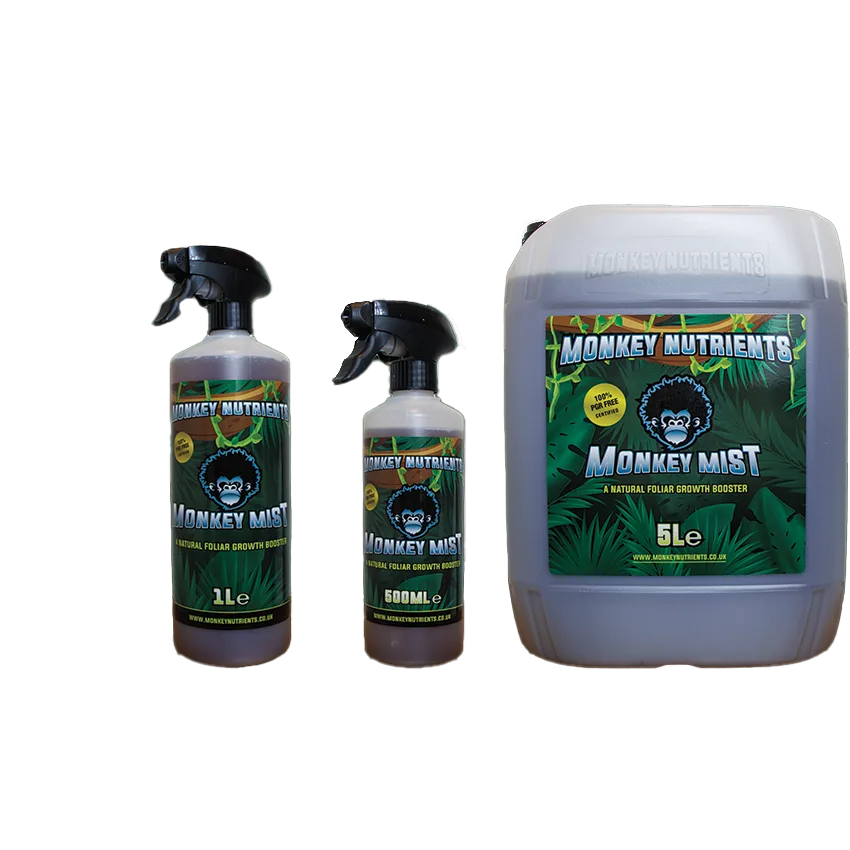
Monkey Mist
Monkey say it helps plants bounce back from pest pressure. It is a foliar feed, not a pest control, so use it for recovery once the mites are under control.
Ready to use, no mixing. Mist evenly over the tops of the leaves in propagation, growth and early flower only. Safe with the lights on. Never spray maturing flowers.
View product →Products support a healthy plant. They don't replace fixing the cause.
When to get help
If webbing reaches the flowers, or numbers keep rising after two predator releases, ask your biological control supplier for advice, or email info@monkeynutrients.co.uk with clear photos of the leaf undersides.
Email info@monkeynutrients.co.ukRelated problems
Sources
Advice is general guidance from Monkey Nutrients and UK horticultural sources. Always read product labels.